




Published 16 Apr 2026
What Is HS? How to Tell If Your Painful Bumps Could Be Hidradenitis Suppurativa
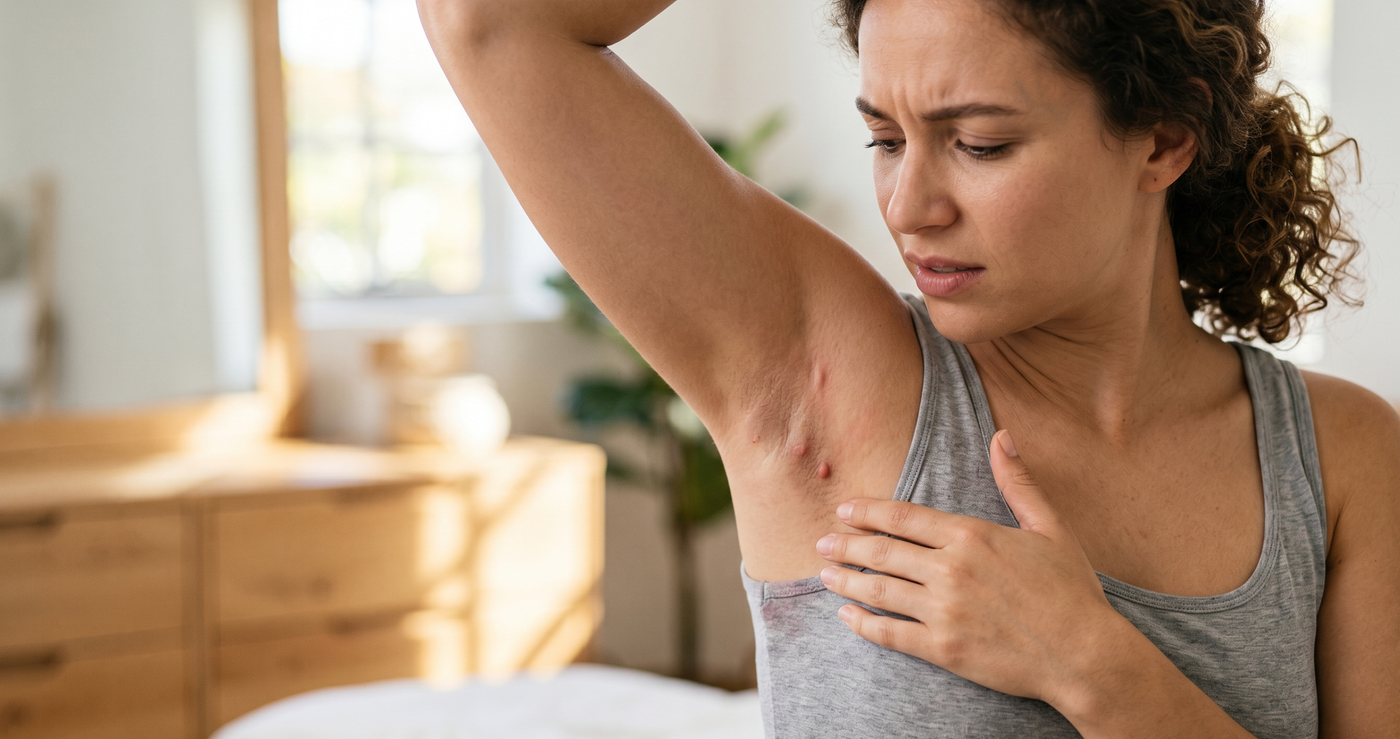
Table of Contents
Introduction What Is HS? Where on Your Body Do HS Bumps Appear? What Do Nodules Under the Skin Actually Feel Like? What Other Symptoms Come with HS? How Is HS Different from Regular Acne or Boils? Could Your Painful Bumps Be HS? Here Is How to Tell How to Support Your Skin During HS Flare-Ups The TakeawayIntroduction
Sarah had been dealing with painful bumps under skin in the same spot under her arm for three years.
She had seen two doctors. Been told it was acne. Then a cyst. Then just something she needed to keep clean. She had tried three different cleansers, two prescription creams, and more spot treatments than she could name...
And every few weeks, without fail, it came back.
Sound familiar? Just like Sarah, thousands of women are managing painful, recurring bumps that have never been properly explained.
Treated wrong, labeled wrong, sent home with the wrong solution again and again. Because the real question nobody asked her was... what is HS?
Because that is what she had. And it had nothing to do with her hygiene, her habits, or anything she could have prevented.
In this article, we'll walk you through what is HS, what these painful bumps feel like under the skin, the key signs that could tell you whether what you're dealing with is hidradenitis suppurativa, and how you can properly support your skin when this flare-up occurs.
What Is HS?
Hidradenitis suppurativa, or HS, is a chronic inflammatory skin condition that affects the hair follicles in skin-fold areas of the body. It is not a surface infection. It is not caused by poor hygiene. It is not contagious.
What is HS at its root?
It is an immune-driven condition where the body's inflammatory response misfires repeatedly in specific locations, producing painful, recurring lesions that can worsen over time if left unaddressed.
Women are disproportionately affected, particularly those in their 20s, 30s, and 40s. Most wait years before receiving a correct diagnosis.
If you have been dismissed or handed the wrong answer, you are not behind. You are in the majority.

Where on Your Body Do HS Bumps Appear?
HS is not random. It targets specific skin-fold areas where friction, heat, and sweat concentrate, and that location pattern is one of the clearest signals that painful bumps under skin could be pointing to something more specific than a one-off irritation.
The most commonly affected areas include:
- Underarms (painful bumps under armpits are among the most frequently reported early signs)
- Inner thighs and groin
- Under and on the breast
- Buttocks and between the cheeks
- Nape of the neck

One bump in isolation might mean nothing. The same spot flaring for the third time this year, always in a skin-fold area, is a pattern worth taking seriously.
What Do Nodules Under the Skin Actually Feel Like?
This is where HS separates itself from anything surface-level.
Nodules under the skin feel firm, deep, and pressure-building. Not a bump that surfaces overnight and clears in a few days.
The kind that sits below the surface and builds... that makes it uncomfortable to raise your arm, wear fitted clothing, or sit in certain positions depending on where it appears.
The progression matters too. What starts as a nodule can develop into an abscess, a painful collection of fluid beneath the skin that may eventually drain on its own.
In more advanced cases, tunneling forms under the skin, creating pathways connecting one lesion to another. You may not see it, but you can feel it.
A painful pimple under arm that never fully drains, never leaves a clean surface, and returns in the exact same spot is not behaving like a typical pimple. That pattern is exactly the point.
What Other Symptoms Come with HS?
The bumps are the most visible sign. But HS rarely shows up as bumps alone.
The fuller picture tends to include a combination of the following:
- Recurring swollen lumps or abscesses that keep returning in skin-fold areas
- Pain that intensifies and builds before the bump fully surfaces
- Fluid drainage from open bumps, sometimes with odor
- Darkening or scarring in areas that flare repeatedly
- Flares that consistently worsen in the days before your menstrual cycle
- Bumps under armpits that hurt with everyday movement like lifting or reaching
- Tracks or tunnels forming under the skin in more advanced stages
No single symptom on this list confirms HS on its own. But the more of these you recognize together, the more the picture comes into focus. HS presents as a pattern, not a single isolated event.
That is what makes it so easy to miss for so long.
How Is HS Different from Regular Acne or Boils?
This is the question that keeps a lot of women stuck for years.
Regular acne lives primarily on the face and at the skin's surface. HS lives deep in skin folds and returns in the same exact locations regardless of what you apply to it.
Topical acne products address surface-level bacteria. They have no meaningful impact on the inflammatory process driving HS beneath the skin, which is why they never worked for you.
Ingrown hairs resolve. A nodule that keeps returning in the same spot along your inner thigh or under your arm is not behaving like an ingrown hair.
A single boil is typically a localized bacterial event. HS is a chronic inflammatory condition.
Antibiotics may provide temporary relief in some cases, but they are not addressing the underlying process... which is why so many women find themselves back at square one a few weeks later, wondering what they are doing wrong.
The answer is nothing. The root of HS is inflammation, not infection. That distinction changes everything about how you understand it and how you approach supporting your skin through it.
Could Your Painful Bumps Be HS? Here Is How to Tell
Everything above points toward one question: does this match?
If you are experiencing recurring bumps specifically in skin-fold areas, if those nodules under the skin feel deep and pressure-driven rather than surface-level,
If they drain and return, if your flares track with your cycle, if standard acne treatments have never made a meaningful difference... these are the conditions that consistently point toward HS.
A dermatologist diagnoses HS through visual examination and symptom history. There is no single blood test that confirms it.
What matters most is the pattern: the type of bumps, their location, and how consistently they keep returning.
Getting an accurate picture early gives you the best chance of managing HS before it progresses further.
If this matches what you have been living with, seeing a dermatologist is the right next step. You deserve a real answer, and you deserve it sooner rather than later.

How to Support Your Skin During HS Flare-Ups
Many women managing recurring HS flare-ups in the areas it hits hardest need something that goes beyond surface-level care.
Something gentle enough for inflamed skin folds, consistent enough for daily use, and reliable enough to reach for before things get bad.
Many customers in our community describe exactly that experience with Universal Flare Care.
Rooted in a surgeon-passed-down formula trusted for generations, Universal Flare Care works in three stages.
- First, it helps soothe and calm the skin during a flare.
- Then propolis and egg yolk extract work together to help draw out inflammation and calm irritated skin.
- Finally, beeswax forms a breathable barrier that supports the skin's natural recovery and helps protect against the next flare.
Each ingredient earns its place. Propolis works to calm irritated skin. Egg yolk extract nourishes and helps restore the skin barrier. Olive oil hydrates. Beeswax seals and protects. Lavender calms at a concentration gentle enough for active flare-ups.
Universal Flare Care is well tolerated when used as directed on the areas HS most commonly affects: underarms, inner thighs, groin, and under the breast.
For deeper flare-ups, apply a generous layer and cover with cotton gauze overnight. Morning and night, consistently, is where the difference is felt.
Many customers in our community managing recurring skin flare-ups report noticeably calmer skin within the first few days of consistent use. Results vary from person to person.
Trusted by over 500,000 customers worldwide, Universal Flare Care is the kind of daily support that does not ask you to wait until things get bad before you reach for it.
If you are applying it for the first time or to a sensitive area, perform a patch test first. If your symptoms persist or worsen, consult a healthcare professional.
The Takeaway
HS is one of the most misunderstood skin conditions out there. The bumps are real. The pain is real. And the years of being handed the wrong answer are not something you imagined.
Now you know what is HS, where it shows up, what nodules under the skin actually feel like from the inside, and exactly what separates it from the conditions it gets mistaken for most.
If this article mapped onto your experience, the next step is a dermatologist who can give you a proper diagnosis and a clear path forward.
And in the meantime, your skin still needs daily support. Something gentle. Something consistent. Something that shows up every day, not just when things get bad.
That part, you do not have to figure out alone.

