




Published 17 Apr 2026
Staph vs Strep Skin Infections: What's the Difference and When to Get Help
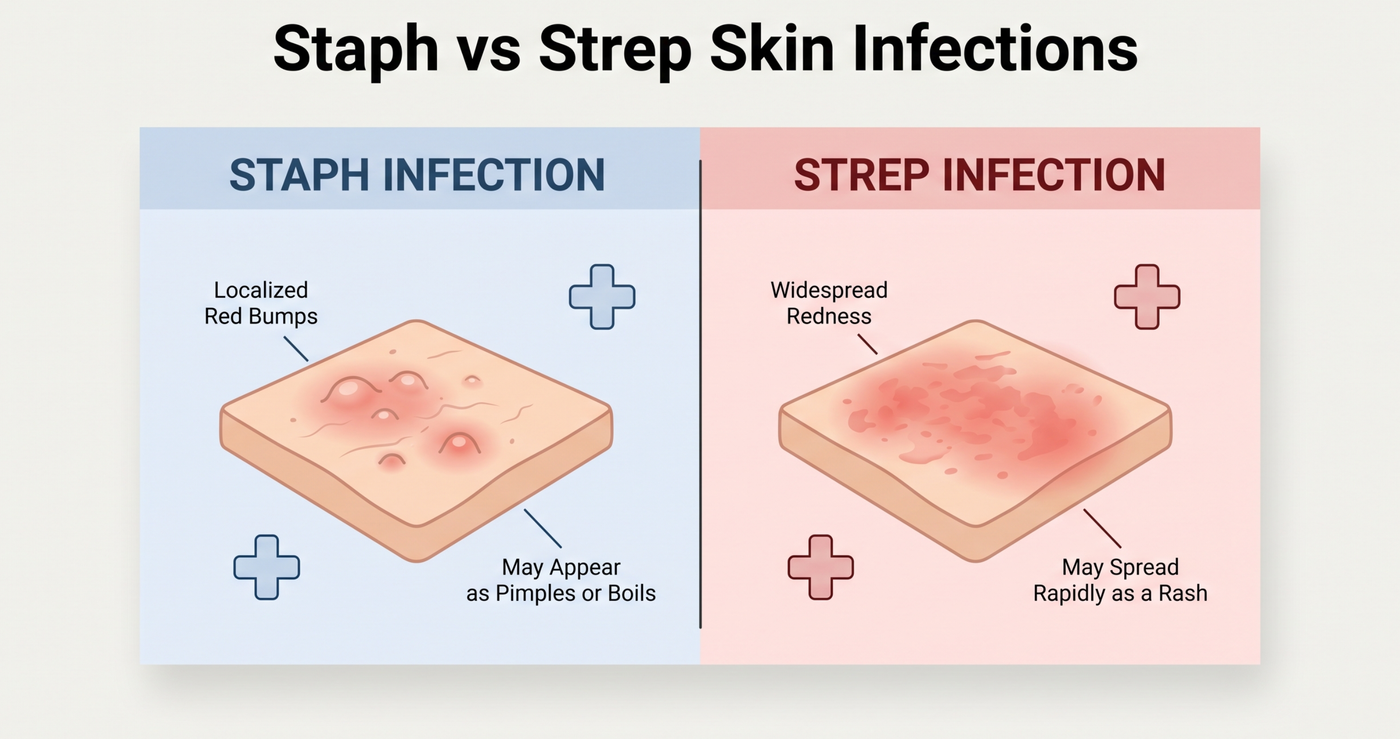
Table of Contents
Introduction What Is a Staph Infection on the Skin? What Does a Strep Skin Infection Actually Look Like? What Is the Difference Between Staph and Strep Skin Infections? What Is a Post Streptococcal Skin Rash? When Should You See a Doctor for a Skin Infection? What Can You Use to Support Your Skin During and After a Flare? The TakeawayIntroduction
You noticed a red, swollen patch on your skin. You put something on it. It didn't move. You tried something else. Still there.
So you went searching online... and found yourself in a fog of symptoms where a staph infection looks like a strep infection looks like an allergic reaction looks like something else entirely.
Same photos. Same vague answers. Same circle.
That's not you being careless. That's not you missing something obvious.
These are two infections that genuinely present themselves like twins on the skin, and most of the content out there about them reads like it was written for a textbook, not for someone who actually has a spot on her body that won't quit.
You're not going to sit and let that keep happening. So here's what you actually need to know: a staph infection and a skin streptococcus infection are two different bacteria, two different behaviors, and two completely different patterns on the skin.
Knowing which one you're dealing with is not a minor detail. It changes everything about what you do next... including when you get help.
What Is a Staph Infection on the Skin?
Staphylococcus bacteria lives on the surface of your skin constantly, without causing trouble. Most of the time, it coexists peacefully.
The problem starts the moment it finds a way in... through a small cut, a scrape, a friction wound, or a patch of skin that's been irritated long enough to break down.
Once inside, a staph infection sets up a concentrated site of inflammation. It builds. It deepens. And the result on your skin is usually unmistakable once you know what you're looking for.
Common signs of a staph skin infection include:
- A raised, tender bump that feels warm or hot to the touch
- Redness and swelling concentrated in one specific spot
- A boil or abscess developing beneath the surface
- Pus or fluid building up inside the bump
- Increasing pain or pressure when the area is pressed

These flares most often show up on the underarms, inner thighs, groin, buttocks, and back... areas where friction, sweat, and hair follicles create the right conditions for bacteria to take hold.
Most cases look manageable at first. That's actually the part worth paying attention to, because left without support, a staph infection can deepen and spread far faster than it looks like it will.
What Does a Strep Skin Infection Actually Look Like?
Most people hear "strep" and picture a sore throat. Skin streptococcus is a completely different animal, and one that gets missed far too often because the association runs so deep.
Streptococcus pyogenes... the specific bacteria behind most skin strep infections... enters through a break or compromised area in the skin and does something staph typically doesn't: it spreads.
Rather than building pressure and depth in one concentrated spot, a skin infection due to streptococcus pyogenes bacteria moves outward across the skin's surface.
What that looks like in practice is a skin rash from strep that covers a broader area than expected.
You might see flat, spreading redness that doesn't seem tied to one central bump. You might see honey-crusted sores forming on the face, legs, or arms... that's impetigo, one of the most recognizable presentations of strep on skin.

Or you might notice a body strep rash that behaves less like a boil building pressure and more like a stain spreading outward, relatively surface-level, difficult to pin to one spot.
That visual difference is the single most important thing to hold onto when you're trying to figure out which one you're dealing with. Staph builds. Strep spreads.
What Is the Difference Between Staph and Strep Skin Infections?
Both are bacterial. Both produce redness, pain, and inflammation. Both can hit the same body areas... the underarms, inner thighs, groin, and other spots where skin is prone to friction or moisture.
That overlap is exactly why the confusion runs so deep, and why getting a professional identification matters more than most people realize.
The real distinction lives in how each infection behaves on and beneath the skin.
Strep skin infections tend to stay closer to the surface and spread laterally. Staph infections concentrate in one location and build depth and pressure beneath the skin. Same body. Two completely different patterns.

That table gives you a framework. What it doesn't give you is a confirmed answer.
The visual similarity between these two infections... and between bacterial infections and other skin conditions like eczema, contact dermatitis, or folliculitis... is too significant for any self-diagnosis to be reliable.
The only way to know for certain which bacteria you're dealing with is through a professional evaluation. That step always comes before a management plan.
That table gives you a framework. What it doesn't give you is a confirmed answer.
The visual similarity between these two infections... and between bacterial infections and other skin conditions like eczema, contact dermatitis, or folliculitis... is too significant for any self-diagnosis to be reliable.
The only way to know for certain which bacteria you're dealing with is through a professional evaluation. That step always comes before a management plan.
What Is a Post Streptococcal Skin Rash?
Here's the part most articles skip entirely: what happens to your skin after a strep infection has been treated.
A post streptococcal skin rash is the body's inflammatory response continuing even after the bacteria has cleared.
You've finished a course of antibiotics. The infection is technically gone. But your skin is still showing up red, reactive, mildly peeling, or irritated in ways that feel like the problem isn't over.
It isn't a new infection. It isn't a sign that treatment failed. It's your skin still working through the aftermath... and it's more common than most people expect, particularly after certain strep strains including group c strep.
What matters most during this window is understanding that your skin's barrier is still compromised and reactive.
The infection may be gone, but the inflammation cycle hasn't fully closed.
This is the phase where consistent, gentle daily skin support makes the biggest difference... not aggressive products, not heavy actives, and nothing that adds more stress to skin that's already been through enough.
If your rash persists or spreads after completing antibiotics, or if new symptoms develop during this phase, that's a clear signal to go back to your healthcare professional rather than waiting it out.

When Should You See a Doctor for a Skin Infection?
Most bacterial skin infections look manageable in the early stages. That's actually the window that matters most... because the earlier you get a confirmed identification, the faster and cleaner the path forward tends to be.
There are specific signs that mean stop waiting and make the call:
- Redness is spreading noticeably beyond where it started
- You develop a fever alongside the skin symptoms
- The affected area becomes deeply swollen, hot, or increasingly painful
- Symptoms are not improving after a few days
- Pus, oozing, or an unusual odor develops at the site
- Streaking lines extend outward from the infected area
That last one in particular is a sign to act immediately. Streaking from a skin infection site can indicate the bacteria is moving toward the bloodstream, which is a medical emergency.
Outside of those urgent signals, the broader principle is this: you cannot build the right skin routine around something you haven't correctly identified.
The overlap between staph, strep, and other skin conditions is too significant. A confirmed diagnosis isn't just the responsible step... it's the only starting point that actually makes sense.

What Can You Use to Support Your Skin During and After a Flare?
A doctor handles the infection. But once the acute phase passes... and especially during the post-flare recovery window... your skin still needs consistent daily support to rebuild properly.
After a bacterial skin flare, the inflammation doesn't stop the moment treatment ends. The skin's barrier is disrupted. The tissue is reactive.
The cycle of irritation has a momentum of its own that doesn't just switch off. What your skin needs during this period is something gentle, consistent, and built for exactly this kind of stress.
Many women in our community who deal with recurring flare-ups on the underarms, inner thighs, and groin reach for Universal Flare Care as part of their daily skin support routine during and after flare-up periods.

It's not a replacement for medical treatment... it's what comes after. The daily layer of support that helps compromised skin actually recover rather than just waiting to flare again.
Universal Flare Care is built on a surgeon-passed-down formula, trusted by over 500,000 customers, and gentle and well tolerated when used as directed on inflamed, irritated, and flare-prone skin.
Each ingredient earns its place in the formula:
- Olive oil hydrates and helps support the moisture barrier on compromised skin
- Beeswax creates a breathable, protective layer over irritated and reactive areas
- Egg yolk extract nourishes the skin and supports recovery at the surface level
- Propolis is known for its skin-calming properties and has been used in traditional formulas for generations
- Lavender essential oil soothes and helps reduce the feeling of discomfort during active flare periods
Many customers in our community report calmer, less irritated skin when using Universal Flare Care as part of their daily routine. Results vary from person to person.
Before use, do a patch test... especially if you're applying to the underarms, inner thighs, or groin.
If you have a known sensitivity to lavender or bee-derived ingredients, check the formula before applying. And if your symptoms persist beyond what daily skin support can address, consult a healthcare professional.
The Takeaway
Here's what to walk away with:
- A staph infection stays concentrated. It builds pressure and depth in one localized spot. A strep infection spreads outward across the skin's surface. Two bacteria, two completely different patterns.
- Skin streptococcus is not a throat problem that ended up on your skin. It is its own condition with its own presentation... and it is more commonly missed than most people realize.
- A post streptococcal skin rash can linger even after the infection clears. That is your body's inflammatory response finishing what it started. It needs gentle, consistent daily support... not more aggression.
- If redness is spreading, a fever develops, or symptoms are not improving within a few days, that is the sign to see a healthcare professional. A confirmed diagnosis always comes before a management plan.
- For daily skin support during and after flare-up periods, Universal Flare Care is the gentle, well-tolerated option trusted by over 500,000 customers... built on a surgeon-passed-down formula for skin that has been through enough.

