




Published 20 Apr 2026
Natural compounds for psoriasis treatment review
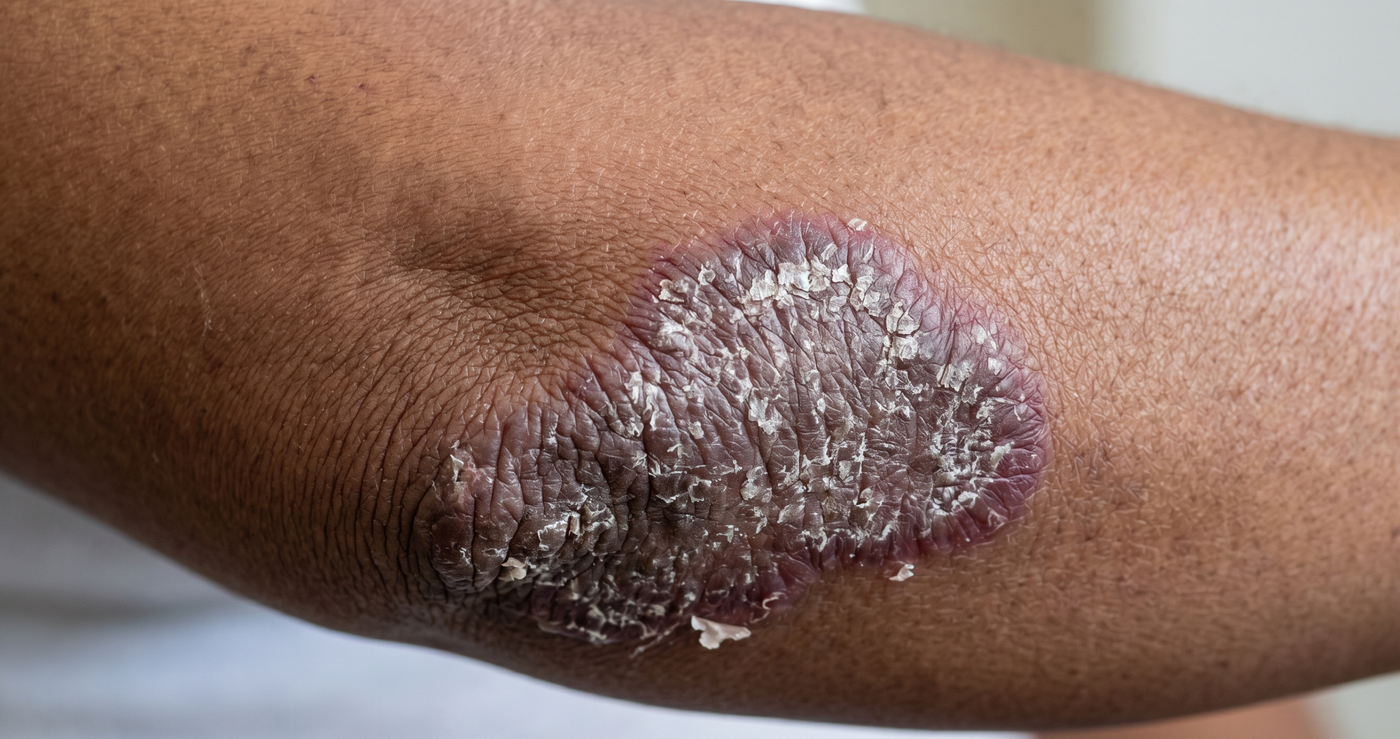
Table of Contents
Introduction What Actually Happens to Your Skin During a Psoriasis Flare Why Your Psoriasis Treatment May Keep Missing the Mark What the Research Says About Natural Compounds for Psoriasis Natural Compounds Studied for Psoriasis Scaling Skin How to Build a Psoriasis Skin Care Routine Around These Compounds What to Realistically Expect From Natural Cures to Psoriasis The TakeawayIntroduction
When you check the medicine cabinet. You see that prescription foam that worked for maybe six weeks before it stopped doing much. The medicated shampoo with the coal tar smell that lingers all day…
The steroid cream the doctor told you not to use too long because it thins the skin over time. The heavy moisturizer that helps a little... until the next flare starts and you're right back where you were.
That routine has been the plan and for a lot of women managing psoriasis treatment, the plan keeps coming up short.
But there are compounds that researchers have been studying for psoriasis for decades... and they don't require a prescription, a new diagnosis, or throwing out everything you're already doing to understand them.
They exist alongside what you're using now. Most people managing this condition have just never been told about them.
Here's what most standard approaches are built around: managing the surface. Slowing what shows up on your skin not addressing the inflammation cycle underneath it that keeps sending the flare back.
The products have been the whole plan. And inflammation doesn't respond to surface-level management forever.
Most people with psoriasis believe this is just management mode for life. That flares are the new normal and the goal is damage control.
That belief didn't come out of nowhere... it's exactly what most routines are designed around. But the research on natural compounds tells a different story.
Your skin was never the problem. The approach you were given wasn't built around what researchers have been finding for the last two decades. You weren't failing. You were working from an incomplete picture.
A published review of naturally derived compounds and their potential in psoriasis... covering phytochemicals, dietary compounds, and plant-based ingredients... points toward a wider toolkit than most routines currently include.
The goal is to reduce psoriasis inflammation alongside everything else you're already doing. Not instead of your doctor. In addition to the plan.
What Actually Happens to Your Skin During a Psoriasis Flare
Psoriasis is an immune-mediated condition.
That means the immune system sends signals that tell skin cells to multiply far faster than they should. In healthy skin, cells turn over roughly every 28 days. In psoriatic skin, that cycle can compress to just a few days.
The result is the buildup you see on the surface... thick, raised plaques coated in silvery scales. That's not just dryness. That's layers of skin cells that never had time to shed properly, stacking up because the turnover cycle won't slow down.
The inflammation isn't just a side effect of the plaque. It's the engine driving it. Any approach that works only on the surface is responding to the output, not the source.
Why Your Psoriasis Treatment May Keep Missing the Mark
If you've been managing this condition for a while, you've probably lived through this pattern. Something works... the plaques thin out, the redness settles, things look better.
Psoriasis before after can look promising... until a few months later when it comes back, and you're back to square one.
Most conventional options are designed to slow the visible response. Steroids reduce surface inflammation. Keratolytics break down the scale but when you stop, the immune signals that drove the flare in the first place don't stop with you.
That's not a failure of any one product. It's a gap between what most approaches are built to do and what the skin actually needs during and between flares. Those are two different jobs, and most routines only handle one of them.

What the Research Says About Natural Compounds for Psoriasis
In a published review by Elkhawaga et al., researchers looked at a wide range of naturally derived compounds and their potential role in psoriasis.
The study examined plants, phytochemicals, and dietary compounds that have been studied for their anti-inflammatory and immune-modulating properties.

Natural Compounds Studied for Psoriasis Scaling Skin
If you've spent any time looking at what drives psoriasis scaling skin, you'll notice the same inflammatory pathways show up repeatedly in the research.
Here is what the studies have looked at closely:
- Curcumin (from turmeric)... studied for its influence on key inflammatory signaling pathways. Research has shown it may reduce the activity of immune signals that tell skin cells to overproduce. It is one of the most researched plant-based compounds connected to psoriasis and the inflammation cycle beneath the surface.
- Aloe vera... contains salicylic acid, which has keratolytic properties, alongside compounds that may support the skin's immune response. Clinical studies have compared aloe vera gel directly to conventional options in psoriasis patients, with some positive findings on redness and plaque reduction.
- Omega-3 fatty acids (from fish oil)... studied for their anti-inflammatory effect on the immune response. The research points toward their potential to help shift the balance away from the pro-inflammatory signals that drive flares.
- Vitamin D... plays a direct role in regulating the behavior of keratinocytes, the skin cells that overproduce in psoriasis. Topical vitamin D derivatives are already used clinically in some psoriasis protocols, and the research into its role in the inflammation cycle is well established.
- Mahonia aquifolium (Oregon grape)... contains berberine, an alkaloid studied for its anti-inflammatory action. Clinical findings suggest it helped reduce plaque severity in patients with mild to moderate psoriasis vulgaris.
Each of these connects to a mechanism researchers have identified as relevant to the inflammation cycle in psoriasis.
That's the difference between a compound with real evidence behind it and one that's just popular right now.
How to Build a Psoriasis Skin Care Routine Around These Compounds
Supporting the skin properly during and between flares needs two things above everything else: consistency and gentleness.
Especially during a flare, when the skin barrier is already compromised, adding aggressive products tends to set things back rather than move them forward.
The foundation to build around:
- Gentle cleansing that doesn't strip the barrier further during a flare
- A topical that soothes and supports without fragrance, essential oils, or added irritants
- Consistent use between flares, not just crisis management when things are at their worst
For daily skin support during a flare, what you put on compromised skin matters.

Universal Flare Care Essential Oil-Free is formulated without essential oils and is well tolerated on sensitive and broken skin when used as directed. It is built for every-day use... not just for when things feel unmanageable.
Before adding anything new to your psoriasis skin care routine, do a patch test first. Apply a small amount to a discreet area and wait 24 to 48 hours before using more broadly.
That applies to natural compounds and any new topical product... especially on skin that is already inflamed.
What to Realistically Expect From Natural Cures to Psoriasis
The idea that a natural approach could fully resolve psoriasis shows up in a lot of searches. People looking for natural cures to psoriasis want a way out of the management cycle entirely.
The intent makes complete sense. But no single approach, natural or conventional, has been shown to fully resolve psoriasis for good... and setting that expectation tends to lead people back to square one when any approach falls short.
What the research does support: several natural compounds may help reduce psoriasis inflammation, calm the scaling cycle, and give the skin more consistent daily backing. That's a different goal than a complete resolution. For someone who has been in management mode for years, it's also a more realistic and more useful place to start.
Many customers in our community report that pairing daily skin support with a more consistent routine makes flares feel more manageable. Results vary from person to person.
If your symptoms persist or worsen, consult a healthcare professional. Natural compounds work best as part of a broader approach... not as a replacement for medical guidance.
A dermatologist familiar with both conventional and complementary options can help you figure out where these compounds fit for your specific situation.
The Takeaway
The research on natural compounds and psoriasis keeps pointing toward the same idea: addressing the inflammation cycle underneath the surface matters as much as managing what appears on top.
Compounds like curcumin, aloe vera, omega-3 fatty acids, vitamin D, and mahonia aquifolium have all been studied for their potential to support the skin during a psoriasis flare...
And each one connects to a mechanism researchers have identified as directly relevant. That's not a complete solution. It is a different starting point than most routines offer.
Building a consistent daily routine around gentle, fragrance-free support doesn't have to be complicated.
Patch test everything new. Go slow on inflamed skin and don't expect results overnight... the skin needs steady support between flares, not just a reaction when things get bad.
Talk to your doctor before making changes to any existing treatment plan.
If you're looking for a daily topical that's gentle enough for compromised skin and formulated without essential oils, Universal Flare Care Essential Oil-Free is built for exactly that kind of consistent, every-day use.

