




Published 17 Apr 2026
MRSA or Just a Boil? Signs You Shouldn't Ignore
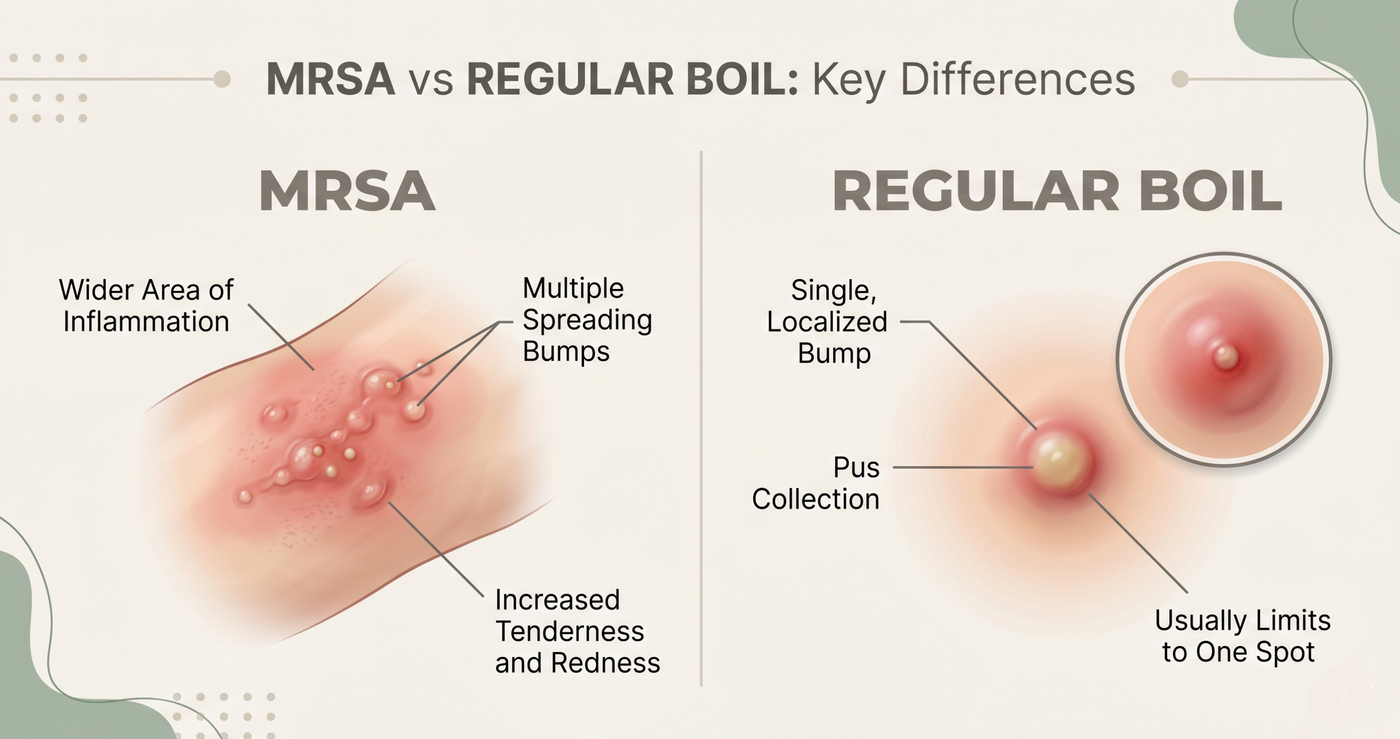
Table of Contents
Introduction What Do Boils Look and Feel Like? What Is MRSA and Why Should You Know About It? MRSA Symptoms vs Regular Boils: How to Tell the Difference Where Do Boils and MRSA Show Up Most? When Should You See a Doctor for a Boil? What Does Boil Treatment Actually Look Like? How to Support Boil-Prone Skin Every Day The TakeawayIntroduction
Every woman who's ever had a painful lump under her skin has heard the same thing. "It's just a boil. Put a warm compress on it. It'll go away." And most of the time... that advice works. The bump runs its course. The pain fades. You move on and forget about it.
But here's what nobody tells you when that advice stops working.
You've done the compress. You've kept it clean. You've waited. And this time, the bump didn't shrink... it spread. The redness pushed past the edges.
The pain deepened instead of fading. Maybe you even ran a fever and couldn't figure out why. And that routine you've trusted for years?
It failed you. Not because you did it wrong... but because what you're dealing with this time isn't what you think it is.
Some boils aren't caused by ordinary staph. They're caused by MRSA... a strain of bacteria that resists the very antibiotics most doctors reach for first.
It looks the same on the surface. It starts the same way. But underneath, it's a completely different fight.
And the longer you assume it's just another bump that'll pass on its own, the more ground you're giving it.
The good news? The difference between a regular flare and something more serious comes down to a handful of signs you can recognize right now.
You don't need a lab test to know when something's off. You just need to know what to look for. That's exactly what this article walks you through... so the next time a bump shows up, you know exactly what to do.
What Do Boils Look and Feel Like?
A hard, painful lump starts beneath the surface. You might feel it before you see it... a firm, tender knot under the skin that wasn't there yesterday.
Over the next few days, it pushes upward. The area turns red. It swells. And eventually, a visible center forms as pus builds underneath.
Most of these inflamed bumps follow a predictable pattern. Here's what you're likely to notice:
- A tender, firm lump that develops under the skin over a few days
- Redness and swelling that gradually increases around the area
- A white or yellow center becoming visible as pus accumulates
- Pain that gets worse with any pressure, movement, or friction
- Noticeable warmth radiating from the affected spot
If this is your first time dealing with one, it can look alarming. If it's your fifth or sixth, you might be tempted to shrug it off.
Either way, the bump itself is only part of the story. What matters most is what's causing it underneath... and whether the infection behind it is something your body can handle on its own or something that's going to fight back against standard care.
What Is MRSA and Why Should You Know About It?
Most people carry staph bacteria on their skin and don't even know it. It lives on the surface, usually causing no problems at all.
But there's a strain of that same bacteria that has learned to resist many of the antibiotics doctors reach for first...
And when it gets beneath the skin through a small cut, a razor nick, or an irritated hair follicle, the infection it creates can look identical to a regular skin flare on the outside while behaving very differently underneath.
This type of drug-resistant staph doesn't stay contained the way a typical bump does. It pushes harder. It spreads faster. And the usual first-line medications often can't touch it.
Here's the part most people don't realize... you don't have to be in a hospital to encounter it.
This resistant strain lives on shared towels, gym equipment, razors, and surfaces in locker rooms and communal bathrooms.
It spreads through skin-to-skin contact. It thrives in warm, damp environments. You can carry it without knowing and pass it along just as easily.
That's why understanding what MRSA actually is... and how it behaves differently from ordinary bacteria... matters more than most people think.
MRSA Symptoms vs Regular Boils: How to Tell the Difference
This is the question that brought you here, and it deserves a straight answer.
Mrsa symptoms can overlap with a standard skin flare so closely that it's nearly impossible to tell the difference just by looking.
But there are warning signs that separate the two... and recognizing them early changes everything.
A typical painful lump runs its course. It forms, it peaks, it drains, and the skin starts to recover. A drug-resistant infection doesn't follow that script. It escalates instead of resolving.
It spreads instead of staying contained. And it often brings symptoms that have nothing to do with the skin at all.
Here are the warning signs that a skin flare may involve drug-resistant staph:
- The redness is expanding well beyond the edges of the original bump
- Red streaks are moving outward from the site... a possible sign the infection is reaching your bloodstream
- You're running a fever, dealing with chills, or feeling body aches alongside the skin issue
- The bump hasn't responded to warm compresses or basic home care after several days
- You keep getting recurring painful lumps in the same areas... underarms, inner thighs, groin
- Multiple inflamed bumps are appearing at the same time or in clusters
If you recognize even two or three of these signs happening together, that bump deserves more than a wait-and-see approach.
Mrsa symptoms tend to stack... they don't show up one at a time and politely announce themselves. They build.
And the longer you wait to take them seriously, the harder the situation becomes to manage.
Where Do Boils and MRSA Show Up Most?
These painful skin flares tend to form in areas where your skin deals with the most friction, heat, and moisture. That means the places you'd rather not talk about are usually the ones most affected.
The most common areas include your underarms, inner thighs, groin, under or on the breast, buttocks, and the back of the neck.
These are spots where skin folds press together, where sweat gets trapped, and where hair follicles are constantly being irritated by clothing, movement, and heat.
If you're noticing boils returning to the same area over and over, that pattern matters. Recurring flares in the same spot don't just mean bad luck.
They mean the skin in that area is under ongoing stress... and it's not getting the support it needs between episodes.

When Should You See a Doctor for a Boil?
Not every inflamed bump needs a doctor's visit. A small, uncomplicated one that comes to a head and drains on its own can usually be managed at home with warm compresses and good hygiene. But there's a clear line... and crossing it means you need professional help.
See a healthcare professional if the lump is larger than a coin and still growing, if the pain is severe or worsening, if you develop a fever, or if red streaks are spreading from the site.
These are signs that the infection may have moved beyond the surface, and waiting longer only gives it room to get worse.
If your doctor suspects drug-resistant staph, mrsa treatment usually involves antibiotics specifically chosen to target resistant bacteria.
In some cases, the infection will need to be drained in a clinical setting under sterile conditions... not at home, not by yourself.
This is worth repeating: never squeeze, pop, or try to drain an inflamed lump on your own.
You might think you're relieving pressure, but you could be pushing the infection deeper into the tissue and making things significantly worse.
If you're seeing the kind of mrsa symptoms we covered earlier... fever, spreading redness, red streaks... let a professional handle it.
Always consult a healthcare professional if symptoms persist or if the infection appears to be spreading.
What Does Boil Treatment Actually Look Like?
The right approach depends entirely on severity. For a mild skin flare with no signs of spreading infection, boil treatment is straightforward.
Apply a warm, moist compress to the area several times a day. Keep the skin clean. Avoid tight clothing that creates friction over the bump. And give it time.
If the lump is deeper, larger, or not clearing up on its own... a doctor may perform an incision and drainage. A quick procedure done under local anesthesia to allow the pus empty and relieve pressure.
This is one of the most effective approaches for stubborn infections, and it allows the area to begin recovering properly.
Antibiotics may be prescribed if the infection is extensive, recurring, or if lab results confirm drug-resistant staph involvement.
In those cases, mrsa treatment involves more targeted medications... your doctor will choose specific antibiotics based on the strain's resistance profile, not just a general prescription.
For mild cases that stay at the surface, over-the-counter pain relief and consistent warm compresses are usually enough.
The key is knowing which category your situation falls into... and not managing a serious infection like a minor inconvenience.

How to Support Boil-Prone Skin Every Day
Medical care handles the infection itself. But what about the skin around it?
If you're dealing with recurring flare-ups... the soreness that lingers, the irritation that stays even after a lump has drained, the discomfort that makes you dread the next one... your skin needs consistent, gentle daily support between episodes.
That's where having the right routine matters. Not a harsh product loaded with chemicals you can't pronounce.
Not something that burns on contact or dries your skin out further. Something your skin can actually settle into.
Universal Flare Care is a surgeon-passed-down formula rooted in traditional medicine, made with propolis, egg yolk extract, beeswax, and lavender essential oil.

It's designed to soothe irritated, inflamed skin and support comfort for areas that are prone to recurring flare-ups.
You can use it as a daily moisturizer for ongoing comfort, or apply it with the Gauze Method... scoop, apply directly, cover with cotton gauze, and leave it on overnight for deeper support.
If you've been searching for an ointment for boils that's gentle enough for daily use on areas like your underarms, inner thighs, and groin... and made with ingredients you can actually recognize... this is worth a closer look.
Many customers in our community report calmer, more comfortable skin within days of consistent use. And note that results vary from person to person.
Before using, always do a patch test first... especially on areas that tend to be more reactive. Universal Flare Care is for external, topical use on adults 18+.
Avoid contact with eyes and mucous membranes. If you're allergic to eggs, bee products, poplar tree products, or balsam of Peru, consult a healthcare professional before use.
And if symptoms persist or your skin isn't responding the way you expected, consult a healthcare professional.
Daily topical support works best alongside proper medical guidance... not as a replacement for it.
The Takeaway
- Regular skin flares caused by staph are common and painful, but most respond to basic home care with warm compresses and good hygiene
- Drug-resistant infections share a similar appearance but come with escalating warning signs... spreading redness, fever, red streaks, recurring clusters, and lumps that refuse to respond to standard care
- If you suspect a resistant infection, see a healthcare professional sooner rather than later... early attention keeps a manageable situation from becoming a serious one
- For skin that's prone to recurring flare-ups, consistent daily support with something gentle like Universal Flare Care can help soothe irritation and promote comfort between episodes
- Always do a patch test before applying anything new to your skin, and consult a healthcare professional if symptoms persist
Real boil relief isn't just about the one bump in front of you right now.
It's about giving your skin what it needs every day... so the next flare doesn't hit as hard, last as long, or leave you scrambling for answers all over again.

