




Published 17 Apr 2026
HS vs Herpes: How to Tell the Difference (And Why They’re Often Confused)
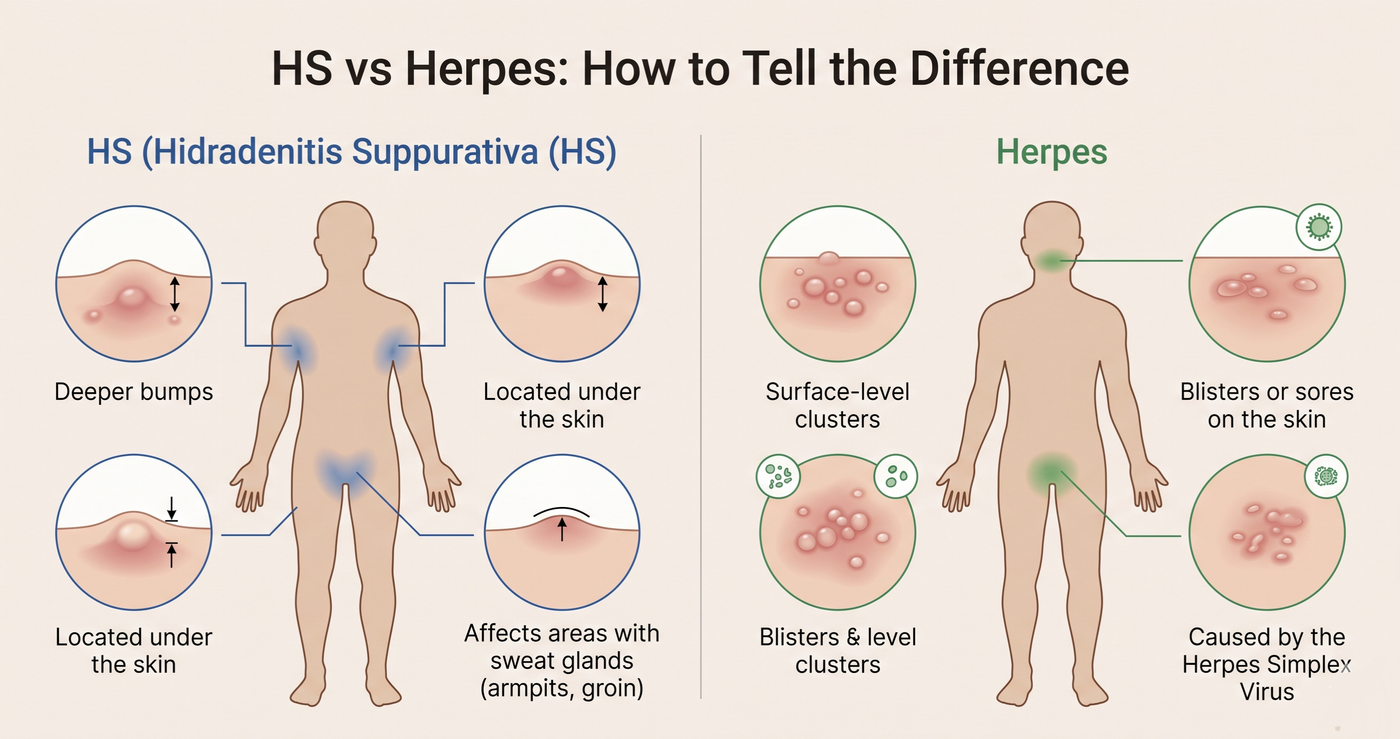
Table of Contents
Introduction Why HS and Herpes on Skin Get Confused What Does HS Look Like? What Does Herpes on Skin Look Like? What Triggers HS vs What Triggers Herpes? HS vs Herpes: How to Tell the Difference What Helps With HS Flares Every Day? Do Natural Remedies Help With Herpes? Getting a Diagnosis Is the First Step The TakeawayIntroduction
Two conditions. Same locations on your body. Same kind of pain. And yet what you do about one has nothing to do with what you do about the other.
That is the part most search results skip over.
HS and herpes on skin get grouped together because they look similar on the surface, and for anyone dealing with a painful recurring flare in the underarms, inner thighs, or groin, that surface-level similarity is enough to make the wrong conclusion feel reasonable.
It is not. And the cost of staying in the wrong lane is months of managing something that was never the real problem to begin with.
Here is what this article gives you: a clear picture of what each condition actually looks like on and under the skin, a solid understanding of what triggers HS flares versus what sets off herpes,
And a practical answer to what helps with HS every day so your skin has consistent support rather than just guesswork.
Why HS and Herpes on Skin Get Confused
The overlap is real, and it makes sense that people mix them up. Both conditions cause recurring, painful flares.
Both show up in areas where skin folds or rubs together... the underarms, inner thighs, groin, and under the breast. And you see, neither condition goes away for good… both have a tendency to come back when you least expect them.
But looking at location alone tells you almost nothing useful. Two conditions can share the same areas on your body and operate through completely different mechanisms.
One is a chronic inflammatory condition. The other is a viral infection that spreads through skin-to-skin contact. That distinction changes everything about how you approach them.

What Does HS Look Like?
HS starts deep. That is the most important thing to understand about it.
The lumps that form with HS are not sitting on top of your skin... they are building pressure underneath it, around blocked hair follicles embedded in the tissue.
By the time you feel them, they have already been developing below the surface for some time.
This depth is what gives HS its distinctive pattern over time. The sores are slow to heal, scarring becomes obvious with repeated flares, and in more severe cases tunnels form under the skin connecting multiple lesion sites.
It is a chronic condition, meaning it does not resolve on its own and tends to worsen without proper management approach.
Common HS Symptoms:
- Deep, painful lumps forming beneath the skin surface rather than on top of it
- Recurring abscesses in the underarms, inner thighs, groin, and under the breast
- Sores that drain slowly and leave noticeable scarring with repeated flares
- Tunnels forming under the skin as the condition progresses over time
- Pitted areas with blackhead-like plugs near affected sites
- Bilateral pattern... the same areas tend to be affected on both sides of the body
What Does Herpes on Skin Look Like?
Herpes on skin is a surface condition. The blisters sit close to the top of the skin, they cluster in tight groups, and they behave very differently from the deep tissue involvement that defines HS.
Where HS builds pressure from the inside out, herpes presents on the outside with small, fluid-filled bumps that are visible almost immediately.
A herpes rash on body tends to appear around the mouth, genitals, or anus. The blisters are shallow and will crust over as they resolve.
Unlike HS, herpes does not typically cause the kind of deep, progressive scarring that comes with repeated HS flares.
The first outbreak is usually the most intense, and subsequent ones tend to be shorter and milder as the body builds a response over time.
Common Herpes Symptoms:
- Small, fluid-filled blisters sitting on the skin surface in tight clusters
- Located around the mouth, genitals, or anus
- First outbreak often accompanied by flu-like symptoms including fatigue and swollen lymph nodes
- Blisters crust over and resolve without the deep scarring pattern HS causes
- Outbreaks recur but typically become shorter and milder over time
What Triggers HS vs What Triggers Herpes?
Understanding what triggers HS is one of the clearest ways to separate it from herpes, because the two conditions are set off by entirely different circumstances.
What triggers HS flares is largely physical and hormonal. Friction in skin folds, hormonal shifts particularly around the menstrual cycle, smoking, excess weight, and genetic predisposition are the most commonly linked factors.
Many women notice that HS worsens during specific hormonal phases, when clothing causes prolonged friction on sensitive areas, or after periods of increased stress on the body.
Herpes outbreaks, on the other hand, are driven by internal immune shifts. The virus is already present in the body and reactivates when conditions allow it... during high stress, illness, fever, sun exposure, or periods of low immune function.
There is no friction, no hormonal component, and no follicle involvement driving it. It is entirely viral in nature, which is what makes the two conditions fundamentally different in how they need to be managed.
HS vs Herpes: How to Tell the Difference
The four clearest distinctions come down to depth, contagion, scarring, and pattern.
Here’s where it gets worse… as these abscesses repeatedly heal and break open again, your skin starts forming scars and tunnels underneath the surface. Dermatologists call these tunnels “sinus tracts,” and they’re basically pathways connecting different lesions under your skin. You can’t see them but you can definitely feel them.
Stage 3 HS:
Severe HS happens when the condition has been going unchecked for a long time. You’ll have widespread lesions, extensive scarring, and multiple tunnels covering entire areas like your armpits or groin. At this stage, you might always have active abscesses. The pain becomes constant, scarring can be thick, ropy, and uncomfortable. Movement gets restricted because the affected areas are so inflamed and tender.
People with Stage 3 HS often need a combination of biologic medications and surgery to manage the condition. The tunneling and scar tissue have to be physically removed because topical treatments can’t reach that deep.

- Depth of lesion. HS forms deep under the skin in blocked hair follicles. Herpes blisters are superficial, sitting on the skin surface. This is the most consistent physical distinction between the two.
- Contagion. HS cannot spread from person to person. It is not an infection. Herpes is a viral infection transmitted through direct skin-to-skin contact and can spread even when no visible sores are present.
- Scarring. HS causes significant, progressive scarring with repeated flares over time. Herpes blisters crust over and heal without leaving the same kind of lasting marks.
- Pattern. HS tends to appear bilaterally in skin folds where friction occurs. Herpes clusters in more localized sites and does not follow the same recurring bilateral skin-fold pattern.
None of this replaces a proper diagnosis.
If you are uncertain which condition you are dealing with, a healthcare professional can confirm it through a physical exam and, where needed, laboratory testing.
Getting that confirmation is not optional... it is the foundation of everything that comes after it.
What Helps With HS Flares Every Day?
Managing HS is not a one-appointment situation. What happens to your skin between appointments matters just as much as the treatment plan your doctor puts in place.
For many women, the daily habits that protect and support the skin barrier are what make the difference between flares that spiral and flares that stay manageable.
A few things that consistently help: wearing loose, breathable clothing in areas prone to friction, identifying and staying ahead of personal triggers, keeping affected areas clean without harsh scrubbing or aggressive exfoliation, and giving your skin consistent topical support to maintain its barrier between flares.
This is where what helps with HS daily goes beyond medical treatment and into everyday skin care.
Many customers in our community report that Universal Flare Care helps soothe and comfort irritated skin in areas like the underarms, inner thighs, and groin where HS flares tend to concentrate. Results vary from person to person.
Universal Flare Care is a surgeon-passed-down formula built on five ingredients, each doing specific work on stressed and inflamed skin:
- Propolis... supports the skin and helps keep affected areas calm between flares
- Lavender essential oil... helps soothe inflamed, reactive skin with a light, non-irritating touch
- Beeswax... forms a breathable barrier over irritated areas without blocking the skin
- Egg yolk extract... nourishes skin that has been through repeated stress and inflammation
- Olive oil... hydrates deeply without aggravating sensitive tissue
Gentle and well tolerated when used as directed for adults 18 and over. Always do a patch test before applying to sensitive areas including the underarms, inner thighs, and groin. If symptoms persist or worsen, consult a healthcare professional.

Do Natural Remedies Help With Herpes?
If you have been searching for natural cures for herpes, here is what you need to know: herpes is a viral infection and antiviral treatment prescribed by a healthcare professional is the medically established path for managing it.
No topical product or natural remedy changes the biology of how the virus operates inside the body.
What lifestyle support can do is help create conditions where your immune system stays stronger and outbreaks may be less frequent over time.
Managing stress, prioritizing sleep, eating a nutrient-rich diet, and reducing known personal triggers all play a supporting role.
But they work alongside medical management, not as a replacement for it. If you suspect herpes, the first step is always a confirmed diagnosis from a healthcare professional.
Getting a Diagnosis Is the First Step
You cannot build the right routine around something you have not correctly identified.
Whether you are dealing with HS or herpes on skin, the path forward starts with a confirmed diagnosis from a healthcare professional who can assess your specific symptoms and recommend the right approach.
From there, what helps with HS long-term is consistency. Keeping your skin barrier supported, staying ahead of known triggers, and giving your skin something gentle it can rely on between flares every single day.
That is not a complicated plan... it is just a committed one.
The Takeaway
- HS and herpes on skin both cause recurring, painful flares in similar body areas, but they are fundamentally different conditions with different root causes
- HS forms deep under the skin in blocked hair follicles; herpes sits on the skin surface as shallow, fluid-filled blisters that crust over and resolve
- HS is not contagious; herpes is a viral infection spread through skin-to-skin contact
- What triggers HS includes friction, hormonal shifts, smoking, and genetics; herpes is triggered by stress, illness, and immune dips
- A healthcare professional must confirm the diagnosis before you build any management plan around it
For daily HS skin support, Universal Flare Care is a gentle, surgeon-passed-down formula that many in the MMH community rely on to soothe and nourish irritated skin in the underarms, inner thighs, and groin between flares... always patch test first, and consult a healthcare professional if symptoms persist

