




Published 17 Apr 2026
HS vs Boils: When Recurrent Bumps Mean Something More
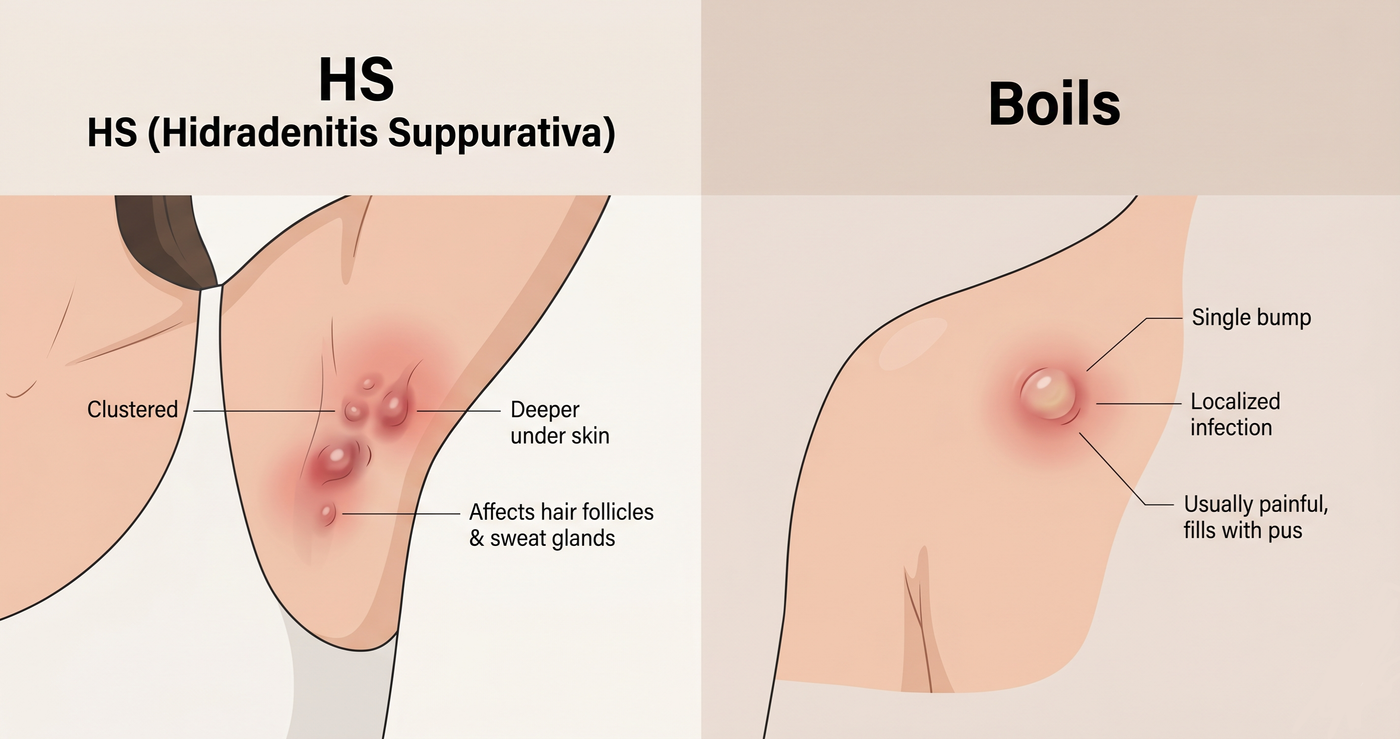
Table of Contents
Introduction Why Do My Boils Keep Coming Back in the Same Spot? HS vs Boils: What Actually Makes Them Different? HS vs Boils: What Actually Makes Them Different? What Causes HS Bumps to Keep Flaring? Where Does HS Usually Show Up on the Body? Do Home Remedies for Boils Help With HS Flares? What Is the Treatment for HS? Why Standard Boil Treatment Falls Short for HS Skin What Ointment for HS Actually Supports Your Skin During a Flare? The TakeawayIntroduction
Again. You drained it. Treated it. Gave it time. And now it's back.
Same spot, same deep ache sitting right where it always does. Your underarm. Your inner thigh. Somewhere it has no reason to return if this were really just a boil.
You've done everything you're supposed to do. Kept it clean. Treated it the way you'd treat boils. Waited. And here you are again, looking at a bump that feels less like a skin issue and more like a pattern you can't break.
Here's the plain truth: what you've been dealing with may not be a boil at all. And it has nothing to do with your hygiene, your skincare routine, or anything you caused.
The fact that it keeps returning to the same spots is the first real signal that the condition driving it is something different entirely.
So... is it any surprise that treating it like a regular bump kept failing? You were solving the wrong problem.
There's a reason these bumps keep coming back. And once you understand what HS actually is and how it works beneath your skin, the approach to managing it changes completely.
Why Do My Boils Keep Coming Back in the Same Spot?
Regular boils are caused by a bacterial infection in a single hair follicle. They swell, fill with pus, drain, and resolve.
That's the whole story and it doesn't come back to the same spot month after month.
When a bump returns to the exact same location on your underarm, inner thigh, or groin over and over again, that pattern is telling you something a one-time bacterial event never would. The condition underneath your skin isn't finishing when the surface heals.
That cycle; same location, same deep inflammation, same frustrating return… is one of the earliest and clearest signals of HS. It's not bad luck. It's a chronic pattern that deserves a real answer.
HS vs Boils: What Actually Makes Them Different?

A regular boil is a bacterial event. One follicle gets infected, swells, fills with pus, and eventually drains. Contained, isolated, and done.
HS is something else entirely. It's a chronic inflammatory skin condition involving the hair follicles and immune system… not a straightforward bacterial invasion waiting to clear.
The lumps it produces can look nearly identical to a boil on the surface, which is exactly why HS gets misdiagnosed so consistently and for so long.
The key difference is what's happening underneath. HS can form sinus tracts tunnels beneath the skin that connect multiple nodules.
When you treat the visible bump and it seems to resolve, those tunnels stay active. The surface heals. The network underneath doesn't. And so it comes back.
What Causes HS Bumps to Keep Flaring?
HS is not a hygiene condition. It's not caused by anything you did to your skin, anything you ate, or any routine you failed to follow.
That needs to be said plainly, because most women dealing with HS spend years blaming themselves before they ever get a real answer.
Current research points to a combination of genetic predisposition, hormonal influences, and immune system dysfunction.
The body misreads signals at the hair follicle level and triggers an inflammatory response that keeps cycling… regardless of whether the surface skin looks clear or not.
You weren't managing this wrong because you weren't trying hard enough. You were managing it wrong because you were working with the wrong information.
Where Does HS Usually Show Up on the Body?
HS concentrates in specific areas; friction zones and places where skin meets skin. These are the spots where clothing creates pressure, where warmth and moisture build, where apocrine sweat glands are most concentrated.
Common HS locations include:
- Underarms
- Inner thighs
- Groin
- Under or on the breast
- Buttocks
The pattern isn't random and it isn't bad luck. HS returns to the same areas because the sinus tracts beneath the skin remain active even when the surface looks clear.
A standard boil can appear anywhere on the body for any isolated reason. HS doesn't work that way… it has territory, and it stays there.
Why Popping HS Bumps Makes Things Worse
The urge to drain it makes complete sense. But an HS nodule is not just the visible surface. There are tunnels beneath it d forcing it to burst, squeeze, or drain can push bacteria deeper into those tracts, where infection becomes significantly harder to manage.
When a burst nodule connects to an active sinus tract, the risk of abscess formation and secondary infection rises considerably. What felt like relief in the moment can set off a much harder cycle underneath.
Anything procedural with HS belongs with a dermatologist. Not at home, and not in front of a bathroom mirror.
Do Home Remedies for Boils Help With HS Flares?
Many home remedies for boils; warm compresses, antibacterial cleansing, keeping the area clean and dry… can offer real surface comfort during an HS flare. That part is true and worth knowing.
But standard boil treatment was designed for a one-event bacterial infection that resolves on its own schedule.
HS is a recurring inflammatory condition with an active network beneath the skin. The logic of one doesn't transfer to the other.
Even a well-formulated ointment for boils targets bacteria in a single follicle… not the chronic inflammation driving HS flares from underneath the skin.
That said, these at-home steps can ease discomfort while you work on a longer-term approach:
- Warm compresses on active bumps to ease pain and encourage drainage
- Loose, moisture-wicking clothing to reduce friction over the underarms, inner thighs, and groin
- Gentle cleansing on affected areas — no harsh scrubbing over active nodules
- Avoiding the razor directly over active bumps
- Keeping affected areas as clean and dry as possible
If symptoms worsen or don't improve, consulting a healthcare professional is the right next step.

What Is the Treatment for HS?
Understanding what is the treatment for HS starts with knowing the condition exists on a spectrum, and that the right approach depends on how active and advanced it is.
For mild cases, topical antibiotics or retinoids are often the starting point… applied directly to reduce surface inflammation and slow follicle involvement.
Moderate to severe cases bring in systemic options: oral antibiotics, immunomodulators, or biologics.
Each carries a significant side effect profile and requires ongoing medical supervision to manage safely.
For advanced cases with developed sinus tracts, surgical intervention enters the picture… de-roofing of tracts, wide local excision, incision and drainage. Real procedures with real recovery time.
A dermatologist is the clinical foundation of long-term HS management. But between appointments, during active flares, and in daily skin care, most women dealing with HS are left without a practical answer for what to actually put on their skin.
Why Standard Boil Treatment Falls Short for HS Skin
What was built for a bacterial infection in a single follicle was never designed for a chronic inflammatory condition with active tunnels beneath the skin.
Those are two different problems and the tools that solve one don't reliably address the other.
Boil treatment is a one-event fix. HS is a recurring condition. Applying the same logic to both is why the flares keep winning; not because you weren't consistent, but because the approach was built for something your skin isn't doing.
Even reaching for a trusted ointment for boils addresses the surface of the problem… not the inflammatory cycle that keeps driving it back.
What HS-prone skin actually needs is consistent, gentle support that works with what's happening underneath rather than assuming this is a bacterial event waiting to clear.
What Ointment for HS Actually Supports Your Skin During a Flare?
Finding an ointment for HS that supports inflamed, sinus-tract-prone skin without aggravating it further is exactly what most women dealing with recurring flares are looking for and rarely finding in standard options.
Universal Flare Care is an ointment for HS flares rooted in a surgeon-passed-down formula, trusted by over 500,000 people.
It works in three stages to support your skin through an active flare:
Stage 1 — Relieves Discomfort: Egg yolk extract and propolis work together to soothe irritation and bring comfort to the flare site.
Stage 2 — Calms: Propolis and the natural lipids in egg yolk extract help reduce redness and ease the sensitivity of inflamed skin.
Stage 3 — Protects: Works to nourish and restore the skin barrier, supporting resilience after a flare.
What it supports:
- Provides relief at active HS flare sites
- Helps ease redness and irritation in the underarms, inner thighs, groin, and under the breast
- Nourishes and supports the skin barrier during active flares
- Gentle enough for daily use — applied as a moisturizer morning and night, or with the gauze method overnight for deeper support on active bumps
Many customers in our community report calmer, more comfortable skin when using it consistently through active flares. Results vary from person to person.
Always patch test before applying, especially on the underarms, inner thighs, and groin.
Well tolerated when used as directed. If symptoms persist or worsen, consult a healthcare professional.

The Takeaway
You now have the full picture. You know what HS is, why it keeps coming back to the same spots, and why treating it like a regular boil was never going to hold.
The right ointment for HS doesn't fight your skin. It works with it — through every stage of a flare and the skin that remains after it clears.
If you're ready to approach your flares with something built for what your skin is actually doing, Universal Flare Care is where to start. Always consult a healthcare professional if you have concerns about your skin or if symptoms don't improve.

